Simple Katsu - Chicken or Pork!
Note: This page contains affiliate links. If you buy through them, I may earn a commission at no extra cost to you. :)
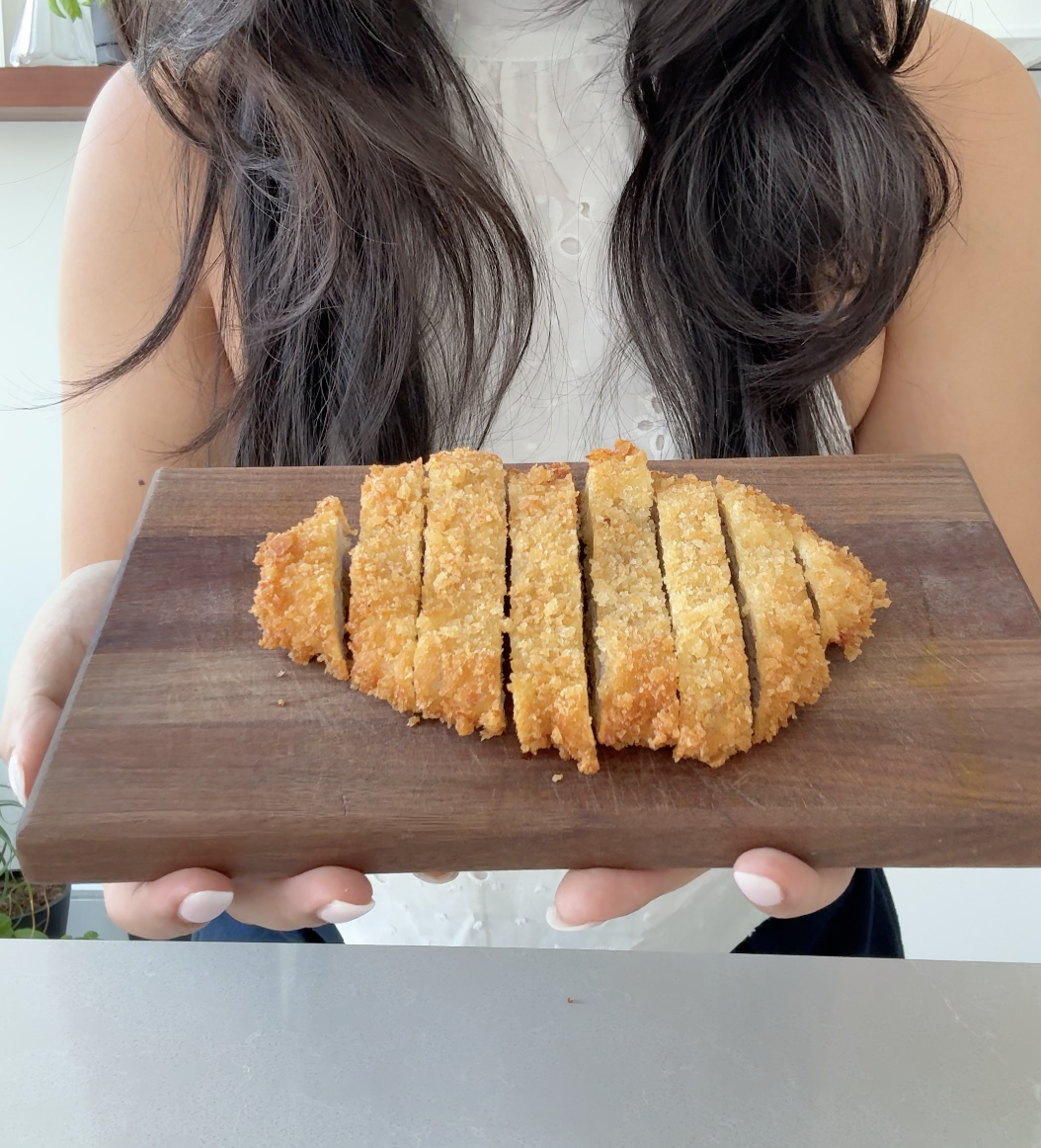
This is originally mentioned in THIS Instagram Post.
Yield: 2 servings · Cooking: 15 minutes
Ingredients:
2 pork loin cutlets or chicken thighs, approximately ½–¾ lb total (see video)
In practice, this might be 1 pork loin, lightly pounded, and cut into 2 portions.
If you’re using chicken thigh, butterfly the thicker half instead of pounding
¼ cup all-purpose flour
1 egg, beaten
1 cup panko bread crumbs
big pinch of salt
1 to 1 ½ inches fry oil of choice in a skillet or pot. I used canola
a sheet tray with a wire rack
Optional: instant-read thermometer
Directions:
Before you start, make sure your protein of choice is an even thickness and lightly pounded. If you don’t have a meat mallet, I like to use a small, weighty glass bottle wrapped in plastic wrap to achieve a similar result. Pound out your cutlet of choice to ¼–½ inch thickness. If you are using chicken thigh, butterfly the thick portion to even the thickness rather than pound the thigh aggressively.
As you prep the breading and cutlet, start to heat up your fry oil on low heat to ~350°F. This does NOT have to be a precise measurement at this point as long as you keep it on the lowest heat while you’re prepping your protein. The exact burner setting will vary. When in doubt, use a thermometer when possible and adjust the heat as needed.
Using a paper towel, dry the surfaces of your protein of choice.
In 3 separate bowls, prepare your flour, beaten egg, and panko + salt mixture.
I’d advise you to throw all unused breading ingredients away afterward, so err on the side of LESS than more to reduce food waste.
Choose if you’d prefer a single-breading or double-breading.
Once you are ready to start frying, turn your flame to a medium-low heat.
First, coat your cutlet with flour on all sides and tap off the excess. It will NOT use a lot of flour.
Next, dip the floured cutlet into the beaten egg. Let the excess drip off.
Lastly, press the panko mixture firmly onto the outside of the cutlet. This will form a crust.
If you’d like a double-breading, repeat steps 8 and 9 before proceeding to step 10.
Check oil for readiness with either a kitchen thermometer for 350F, or dip the tip of your breaded katsu into the oil. If you see a steady stream of small oil bubbles reacting, then the oil is hot enough.
If there are LARGE bubbles, turn the flame off to allow it to cool a bit. When you restart the flame, aim for a lower flame or a smaller burner overall. If there are NO or INCONSISTENT bubbles, let the oil heat up a bit longer.
Place your katsu into the frying oil slowly and facing away from you. Cook in small batches. If you’re only doing 2 cutlets, I would do 1 at a time.
Do not move the cutlet for the first 30 seconds to allow for the crust to set. Allow it to fry for about 5 minutes (single) or 7 minutes (double) or until lightly golden, and flip halfway.
Bring your cooked katsu onto your baking tray with your wire rack.
Transfer the fried katsu to the prepared sheet tray and rack.
Place the rack and sheet pan in your 250°F oven for anywhere from 2 to 15 minutes. This will allow you to regroup, clean up your workspace, and prep the rest of your meal while the katsu stays warm.
Cut into slices, lightly salt if needed, and serve immediately.
FAQ:
Q: How can I pair this?
A: Japanese curry and rice, shredded cabbage, katsu sauce, or a simple lemon wedge!
Q: Can I use chicken breast instead of thigh?
A: Yes, BUT I will advise against it due to a higher likelihood of overcooking, resulting in dry and chewy chicken. However, you can do the same process with chicken breast and a watchful eye.
Q: Why did my coating fall off?
A: Dry the meat well, shake off excess flour and egg, press panko firmly, and let the breaded cutlet rest 5–10 minutes before frying.
Q: Why did my katsu come out greasy and soggy?
A: The oil was likely too cold because the pan was crowded, or the oil was not allowed to reheat between batches. Try again and fry fewer pieces at once.
Q: How can I reheat leftover katsu?
A: Reheat it uncovered on a wire rack in a 375°F oven or air fryer until hot, crisp, and fragrant. Reheat for about 8–12 minutes, depending on thickness and appliance, until hot and crisp.
Q: I don’t have a thermometer. What are some visual cues for my fry oil being ready?
A: Drop a small bit of panko into the oil. You want it to bubble steadily. If it doesn’t, the oil needs to heat more. If the panko darkens right away or the oil creates aggressively large bubbles, lower the heat before frying.
Q: What [tool] did you use?
Everything I used in this video is here (Shop My)